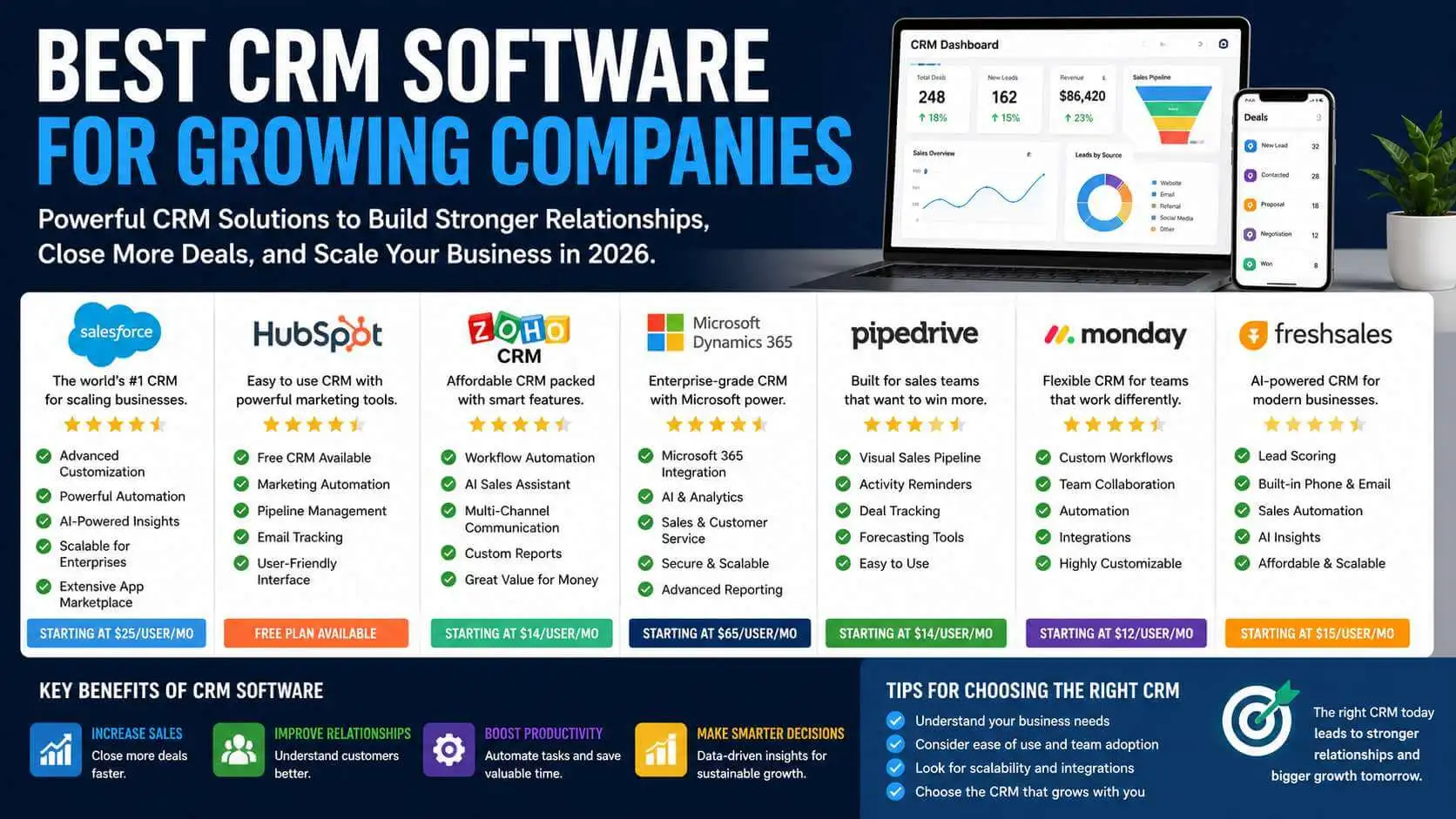
As businesses expand, managing customer relationships becomes more complex. Leads increase, sales pipelines grow, and customer interactions multiply across multiple channels. This is where CRM software becomes essential. The best CRM software for growing companies helps businesses organize customer data, improve communication, automate workflows, and increase revenue.
In 2026, companies of all sizes are investing in CRM platforms to streamline operations and strengthen customer relationships. Whether you’re a startup experiencing rapid growth or an established business looking to scale efficiently, choosing the right CRM can significantly impact your success.
This guide explores the best CRM software for growing companies, key features to consider, and how to select the ideal solution for your business needs.
What Is CRM Software?
Customer Relationship Management (CRM) software is a platform designed to help businesses manage customer interactions, sales activities, marketing campaigns, and support operations.
CRM software allows companies to:
- Store customer information
- Track sales opportunities
- Manage leads
- Automate tasks
- Improve customer service
- Generate business insights
The best CRM software serves as a centralized hub for all customer-related activities.
Why Growing Companies Need CRM Software
As businesses grow, spreadsheets and manual tracking become inefficient.
The best CRM software for growing companies helps by:
- Increasing sales productivity
- Improving lead management
- Automating repetitive tasks
- Enhancing customer retention
- Providing real-time analytics
- Supporting team collaboration
Companies using CRM systems often experience higher sales conversion rates and improved customer satisfaction.
Top CRM Software for Growing Companies in 2026
1. Salesforce
Salesforce remains one of the most popular CRM platforms worldwide.
Key Features
- Advanced sales automation
- AI-powered insights
- Extensive integrations
- Highly customizable dashboards
- Scalable enterprise solutions
Best For
Medium-sized and rapidly growing businesses seeking a powerful and flexible CRM platform.
Pros
- Industry-leading functionality
- Large app marketplace
- Excellent reporting tools
Cons
- Higher pricing
- Steeper learning curve
2. HubSpot CRM
HubSpot continues to be a favorite among startups and growing companies.
Key Features
- Free CRM plan available
- Marketing automation
- Email tracking
- Contact management
- Sales pipeline tracking
Best For
Small and medium-sized businesses looking for ease of use.
Pros
- User-friendly interface
- Excellent free version
- Strong marketing tools
Cons
- Advanced features can become expensive
3. Zoho CRM
Zoho CRM offers an impressive balance between affordability and functionality.
Key Features
- Workflow automation
- AI sales assistant
- Lead management
- Omnichannel communication
- Advanced analytics
Best For
Budget-conscious growing businesses.
Pros
- Competitive pricing
- Extensive customization
- Strong automation capabilities
Cons
- Interface can feel complex initially
4. Microsoft Dynamics 365
Microsoft Dynamics 365 combines CRM and ERP functionality into a single platform.
Key Features
- Deep Microsoft integration
- AI-driven insights
- Customer service tools
- Sales automation
- Business intelligence
Best For
Organizations already using Microsoft products.
Pros
- Seamless Office 365 integration
- Enterprise-grade security
- Comprehensive functionality
Cons
- Higher implementation complexity
5. Pipedrive
Pipedrive focuses on helping sales teams manage pipelines effectively.
Key Features
- Visual sales pipelines
- Lead tracking
- Workflow automation
- Revenue forecasting
- Activity reminders
Best For
Sales-driven organizations.
Pros
- Easy to learn
- Excellent pipeline visualization
- Affordable pricing
Cons
- Limited marketing features
6. Monday CRM
Monday CRM has gained popularity among fast-growing businesses.
Key Features
- Custom workflows
- Project management integration
- Automation tools
- Team collaboration features
- Sales tracking
Best For
Businesses wanting flexibility and simplicity.
Pros
- Highly visual interface
- Easy customization
- Strong collaboration tools
Cons
- Some advanced features require premium plans
7. Freshsales by Freshworks
Freshsales offers AI-powered sales tools designed for growing businesses.
Key Features
- Lead scoring
- Built-in communication tools
- Sales automation
- AI insights
- Contact management
Best For
Companies seeking affordable CRM with strong automation.
Pros
- Competitive pricing
- User-friendly design
- Good customer support
Cons
- Fewer third-party integrations than some competitors
Features to Look for in CRM Software
When evaluating the best CRM software for growing companies, prioritize these essential features.
Contact Management
A CRM should provide a complete view of customer interactions and history.
Sales Automation
Automation helps reduce manual work and improve efficiency.
Reporting and Analytics
Detailed insights help businesses make smarter decisions.
Integration Capabilities
Your CRM should connect with:
- Email platforms
- Accounting software
- Marketing tools
- Customer support systems
Mobile Accessibility
Sales teams need access to customer data from anywhere.
Scalability
Choose a CRM that can grow with your business.
Benefits of Using CRM Software
Implementing the right CRM can deliver significant advantages.
Improved Customer Relationships
Personalized communication increases customer satisfaction.
Increased Sales
Better lead tracking helps convert more prospects into customers.
Better Team Collaboration
All departments can access the same customer information.
Enhanced Productivity
Automation reduces repetitive administrative tasks.
Data-Driven Decision Making
Real-time analytics support strategic planning.
How to Choose the Best CRM Software
Selecting the right CRM depends on your company’s needs.
Consider:
Business Size
Different CRM platforms serve different business sizes.
Budget
Evaluate both current costs and future scaling expenses.
Ease of Use
User adoption is critical for CRM success.
Required Features
Focus on features your team will actually use.
Customer Support
Reliable support can reduce implementation challenges.
Integration Needs
Ensure compatibility with existing software systems.
Common CRM Mistakes to Avoid
Choosing Based on Price Alone
The cheapest CRM may not provide necessary functionality.
Ignoring User Experience
Complex systems often lead to low adoption rates.
Overlooking Scalability
Your CRM should support future growth.
Poor Data Migration Planning
Accurate customer data is essential during implementation.
Lack of Employee Training
Even the best CRM software requires proper training.
Future Trends in CRM Software
CRM platforms continue to evolve rapidly.
Key trends for 2026 include:
- Artificial Intelligence integration
- Predictive analytics
- Advanced automation
- Conversational CRM
- Customer journey mapping
- Enhanced personalization
Businesses adopting modern CRM technologies can gain a competitive advantage.
Conclusion
The best CRM software for growing companies can transform customer management, increase sales productivity, and support long-term growth. Whether you choose Salesforce, HubSpot, Zoho CRM, Microsoft Dynamics 365, Pipedrive, Monday CRM, or Freshsales, the right platform can help streamline operations and improve customer relationships.
Before making a decision, evaluate your business goals, budget, team size, and required features. Investing in the right CRM today can create a foundation for sustainable business growth in 2026 and beyond.
Frequently Asked Questions (FAQs)
1. What is the best CRM software for small growing businesses?
HubSpot CRM and Zoho CRM are often considered excellent options for growing small businesses due to their affordability and ease of use.
2. Which CRM software is best for sales teams?
Pipedrive and Salesforce are highly regarded for sales pipeline management and sales automation.
3. Is CRM software worth the investment?
Yes. CRM software can improve customer retention, increase sales efficiency, and provide valuable business insights.
4. Can CRM software integrate with email marketing tools?
Most modern CRM platforms integrate with popular email marketing and business applications.
5. How much does CRM software cost?
Pricing varies widely, from free plans to enterprise solutions costing hundreds of dollars per user per month.
6. What is the most popular CRM software in 2026?
Salesforce remains one of the most widely used CRM platforms globally, while HubSpot continues to grow rapidly among small and medium-sized businesses.